Introduction
In Overwatch, perks can drastically change the way your character plays. It’s a relatively new feature (which wasn’t present in earlier iterations of the game) so if you’re a returning player or a new player, your might want to know how these perks work. In this article, we’ll explain how hero perks work.
What Are Perks In Overwatch?
Perks are small buffs; these can be active or passive depending on the hero. There are a total of four perks, two minor and two major. You can check your heroes’ perks by pulling up their ability screen (F1 on your keyboard).
When you start a game on a hero, that hero will be at level 1. As you play the game, your hero levels up. When you reach Level 2, you get to choose your minor perk. The prompt appears right near your ult charge meter. When you press the button (Left Alt on your keyboard), you get to choose between two perks.
Minor Perks are small buffs to your abilities, such as cooldown reductions. When you reach Level 3, you get to choose a Major perk. Major perks are more impactful and can change how an ability functions altogether or make an ability really strong.
You don’t necessarily have to do anything special to level up. You will automatically level up as you play the match. Most of the time, you won’t even notice when you have leveled up until you see the perk prompt.
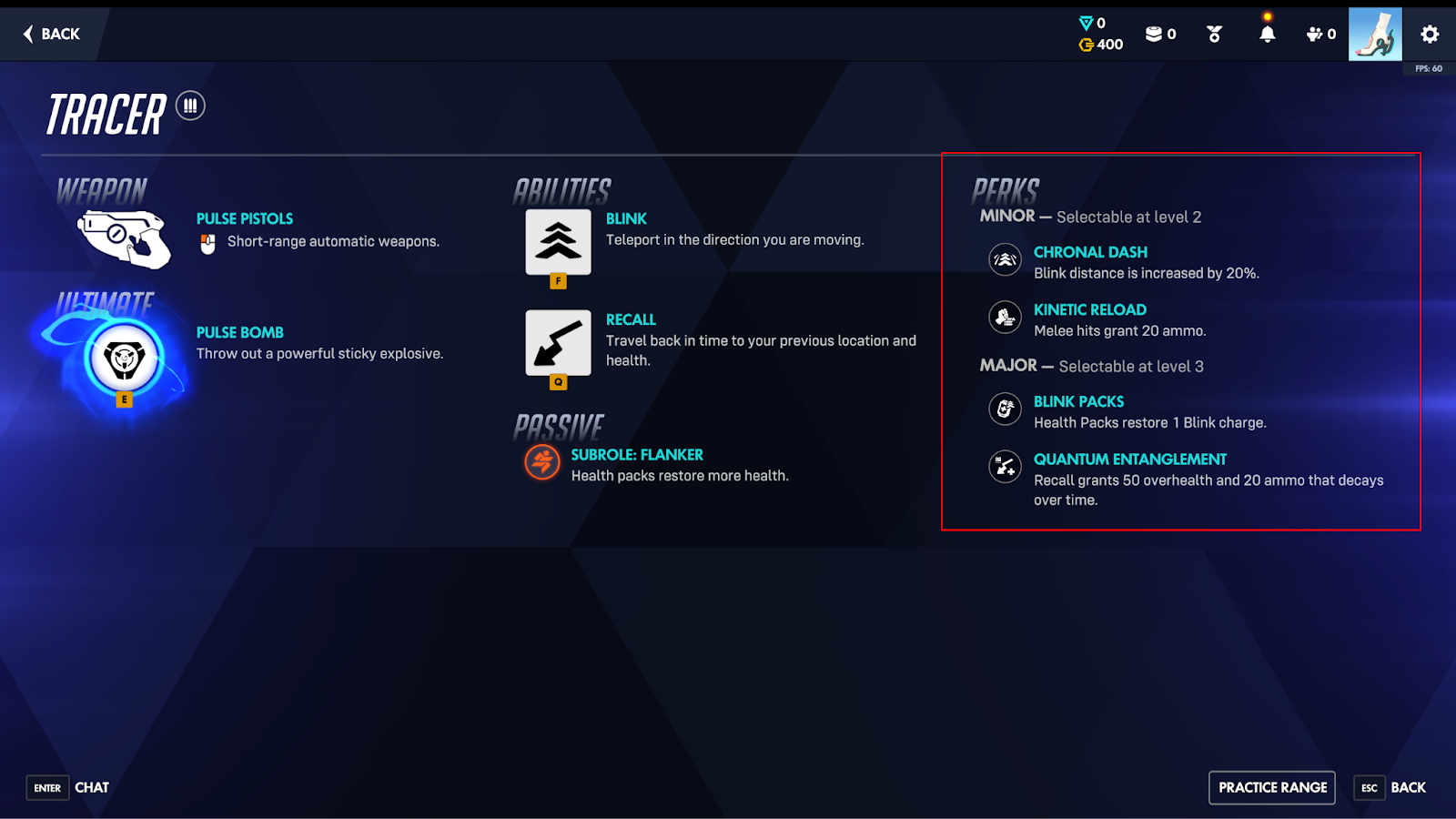
Something that’s extremely important to know is that, once you change your hero, you lose all your progress, even if you switch back to the same hero. You don’t lose your perks between rounds in the same match, however.
Example – Winston’s Perks
Minor Perks
- Electric Charge: Winston gains 10% movement speed for each enemy damaged by his primary fire, up to 30%.
- Heavy Landing: During Primal Rage, Jump Pack’s damage and area increase by up to 75% while airborne.
Major Perks
- Chain Lightning: Fully charged Secondary Fire hits bounce to up to 2 additional targets.
- Revitalizing Barrier: Barrier Projector heals allies within it for 30 health per second.
As you can see, Minor perks give small buffs to your hero. They’re nothing game-changing, but definitely effective. Electric Charge is a really strong perk, as that extra movement speed allows Winston to finish off targets that are running away. If you couple that with Chain Lightning (Major Perk), you’ll have made Winston into a tank that’s a lot more deadly.
On the other hand, the major perk called Revitalizing Barrier makes Winston’s shield more valuable to the team, as it not only protects but also heals.
Since you only get to choose one minor and one major perk during a game, it’s important to consider what suits the moment. If your team’s healers are outputting low healing, for example, you may want to consider Revitalizing Barrier. On the other hand, if you’re getting more than enough heals and lack damage output, Chain Lightning might be the play.
Some perks are always going to be considered ‘worse’ than others, but it’s important to consider your perks in the context of the match and team.
Conclusion
Perks essentially make your heroes stronger during the course of the match. These buffs might feel small, but they do have a huge impact. There are many heroes with game-changing perks that can pull your team from a tough spot. Plus, the ability to choose gives the players a bit more personal control over their heroes, which is always a welcome feature.
Passionate competitive gamer turned writer.

