Introduction
Much like all competitive shooters, Overwatch also has a multi-layered ranking system. If you want to play the game competitively and climb the ranks, then knowledge of this system is necessary. Understanding how you are paired up against other players and what factors affect rank growth are important things every competitive Overwatch player should know.
So, here is a quick explanation of how Overwatch’s ranked system works.
Ranks And Divisions
Over the years, Overwatch’s ranked system has gone through a lot of changes, and it’s reached a point where it’s quite similar to ranked systems seen in other competitive titles like VALORANT and Marvel Rivals.
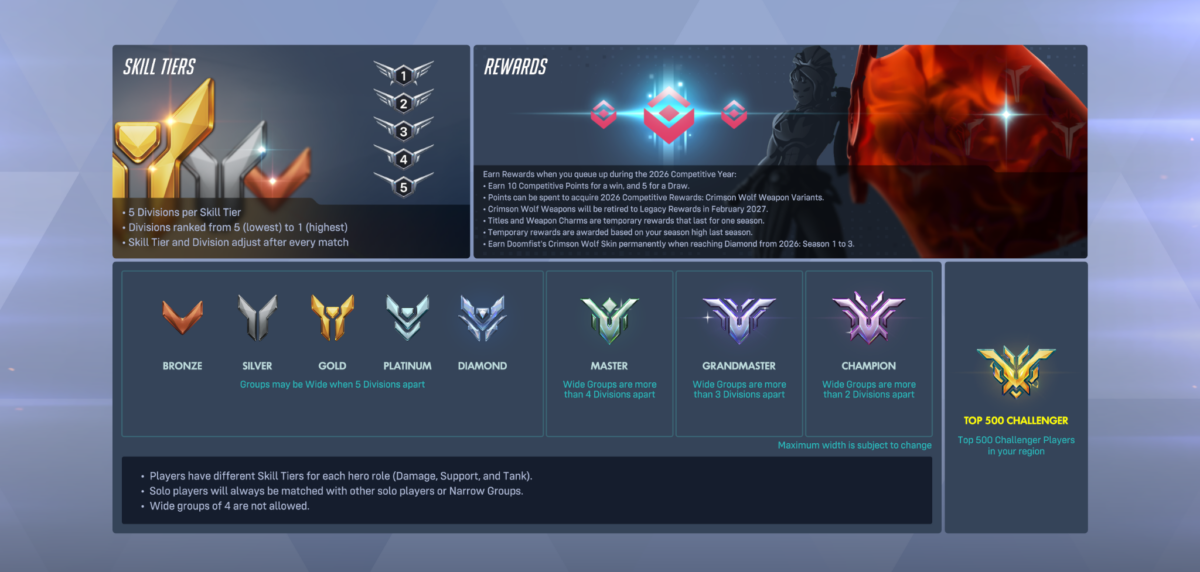
In Overwatch, there are a total of nine ranks, starting from Bronze to Champion and finally Challenger, which is given to the top 500 players of the region. Here are all the ranks in order:
- Bronze
- Silver
- Gold
- Platinum
- Diamond
- Master
- Grandmaster
- Champion
- Challenger
Every rank is further divided into five divisions, namely I to V, with V being the lowest. To climb from one rank to the other, you will have to climb the divisions first. For instance, to climb to Gold from Silver, you will have to climb through Silver V, all the way up to Silver I, and once you reach Gold, you start from Gold V again.
This system remains the same all the way up to Champion. If you want to move to Challenger, which is after Champion, you will have to keep winning matches until you are part of the top 500 players of your region.
Rank Progression
For completely new players on new accounts, you will first have to win 20 matches in Unranked to be able to unlock Competitive. Then, you will have to play ten placement matches in order to unlock your first rank.
In simple words, to move through divisions and ranks, all you have to do is win matches. In theory, if you keep winning more matches than you lose, you will keep climbing the ranked ladder.
When you win a match, you will see a progression bar showing how much you progressed after the win. Overwatch also has a unique system of modifiers that impact how much progress you gained or lost after a match. There are modifiers for different types of situations. Here are a couple of examples of modifiers:
- Winning Trend: If you are on a winning streak, your rank will progress more after you win a match.
- Losing Trend: Similarly, if you are on a losing streak, your next loss will make you lose more rank progress than normal.
- Demotion Protection: A modifier that protects you from deranking once. Demotion Protection only applies during rank demotions and not divisions.
- Leaver Compensation: Adjust the rank increase or decrease if a teammate left the match.
Additionally, behind all of this, Overwatch runs a hidden MMR (matchmaking rating) all the time. This MMR is what is represented through ranks and divisions, but the actual MMR is never displayed. This MMR is pretty much a score for your skill level that the game calculates after every match. The higher MMR you have, the higher-skilled players you will face. Sometimes your MMR can exceed your rank, which is why you are sometimes paired with players outside your rank. Similarly, if your MMR drops down, you can be paired with players lower than your skill level. Think of MMR as a hidden, more calculated system that runs underneath the ranks, divisions, and modifiers we see.
Competitive Queue Modes
When you go over to the Competitive tab (see Overwatch Game Modes, Explained) in Overwatch, you will see two queue modes, Open Queue (6v6) and Role Queue (5v5).
Role Queue forces a team composition of 1 Tank, 2 Damage, and 2 Support. Players have to choose the roles they want to play before they enter the matchmaking queue. Once you are in a match, you can’t choose a hero that’s not in your role. So, if you queued as a Support, you can’t play anything outside the Support role for that match.
In Role Queue, each role has its own 10 placement matches and rank. So, a player can have a different rank for each role.
6v6 is quite the opposite. You don’t have to decide on a role before queuing; you can pick any role you want in the game. 6v6 also doesn’t force a team composition. It only restricts the max number of tanks to two. Apart from that, you can run any composition in the game. 6v6 doesn’t give ranks for individual roles; you only get one rank and only have to play 10 placement matches to unlock it.
Role Queue is the main format for Overwatch esports, so if you want to play the game competitively, you should focus on this mode more.
Rank Resets, Rewards, And Hero Progression
Overwatch’s competitive seasons don’t run forever. Each one lasts a few months, and when a new season starts, your visible rank gets a soft reset.
That doesn’t mean you drop back to Bronze; your hidden MMR just carries over between seasons. All you have to do is play your placement matches, and the system will recalibrate exactly where you are. Generally, you are a couple of divisions lower than your last season rank.
Playing competitive also earns you Competitive Points (CP) along the way. You get 10 CP for a win and 5 CP for a draw, and those points build up as you play the season.
CP can be used towards getting exclusive rewards, such as a unique finish to weapon skins you already own. If you don’t spend your points before the year is up, they don’t just disappear; unspent points roll over into Legacy Rewards.
On top of CP, some rewards are tied directly to rank, and not all of them stick around forever:
- Titles and weapon charms are temporary. You earn them based on the highest rank you hit that season, and they only last until the next one starts.
- Hero-specific skins can be permanent. For example, reaching Diamond at any point across Season 1 through 3 of 2026 permanently unlocked Doomfist’s Crimson Wolf skin.
It’s worth separating rank from Hero Progression, since new players often mix the two up. Hero Progression is a completely separate system that tracks how much you’ve played a specific hero, not how good you are with them.
Every hero levels up independently as you play them in any mode. Hitting level milestones like 20, 50, and 60 unlocks cosmetic portrait borders and badges for that hero. You can be Hero Level 60 on a character and still be sitting in Gold; leveling a hero shows dedication and playtime, not skill. Your competitive rank is the only number that reflects actual matchmaking skill.
Conclusion
Overwatch’s ranking system looks complicated at first, but it really comes down to three things: win matches to climb divisions and ranks, understand that a hidden MMR is running underneath everything you see, and know the difference between Role Queue and Open Queue before you pick one. Role Queue is where you’ll want to spend most of your time if you’re serious about climbing or eventually playing competitively at a higher level, since it’s the format used across Overwatch esports.

