Introduction
VALORANT just gave its competitive tracking systems a pretty huge overhaul. All of this was all introduced in Patch 13.06. The highlight is the new Performance Score that replaces ACS (Average Combat Score), and on top of that, the patch also introduces the new Accolades, Rank Legacy, and a revamped Career page. To help you make sense of it all, here’s everything you need to know about VALORANT’s new Performance Score, Accolades, Rank Legacy, and Career updates.
Performance Score Replaces ACS
The biggest change is straightforward: ACS is out, and Performance Score is in.
For those unfamiliar, ACS, or Average Combat Score, was the main metric used to represent your combat performance in a match. It reflected things like kills, damage, and combat-related assists, but it was still primarily focused on what happened during fights.
The new Performance Score is the fix for that.
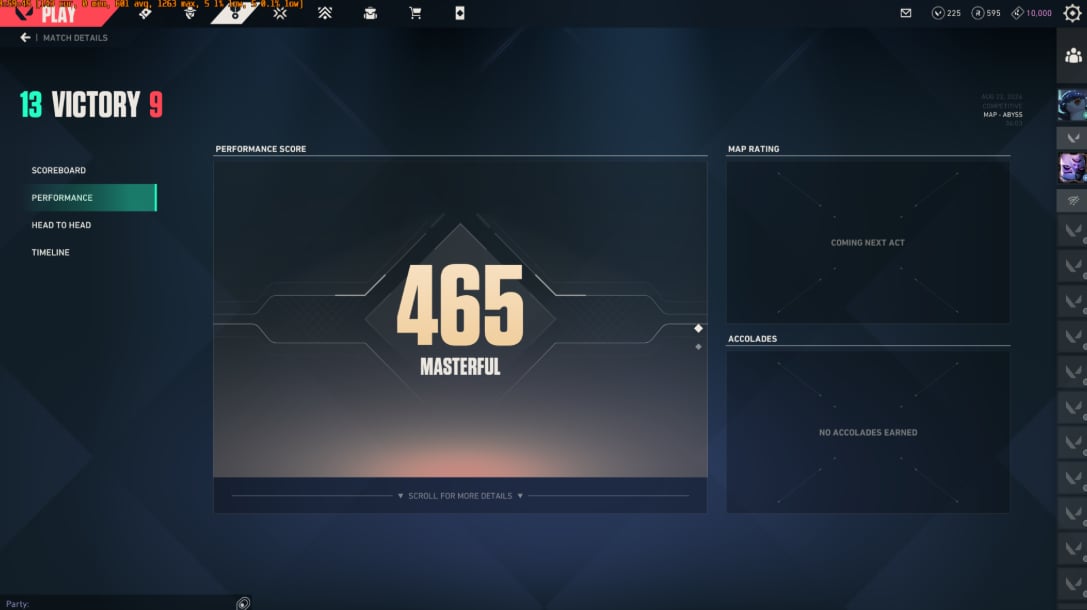
Performance Score is a number between 0 and 500 designed to give players a better picture of their contribution to a match. It is used in Competitive, Unrated, Swiftplay, and Premier. More importantly, Performance Score will be the number that decides who receives the MVP.
The fact that ACS is replaced does not mean Riot Games has decided that kills aren’t important. In fact, Riot Developers confirmed shortly after the update that kills are still one of the most important factors in Performance Score. Think of Performance Score as a broader metric than ACS. It still takes kills into account, but it also factors in other things like trades, utility usage, plants, and defuses.
For instance, a Controller who consistently supports their team, a player who sets up trades, or someone who handles crucial Spike plants and defuses can now have those contributions reflected on the scoreboard instead of watching their ACS suffer simply because they weren’t the one getting every kill.
NOTE: Performance Score does not affect RR. A high Performance Score will not give you extra RR, and a low one will not cause you to lose more.
What Does VALORANT Performance Score Measure?
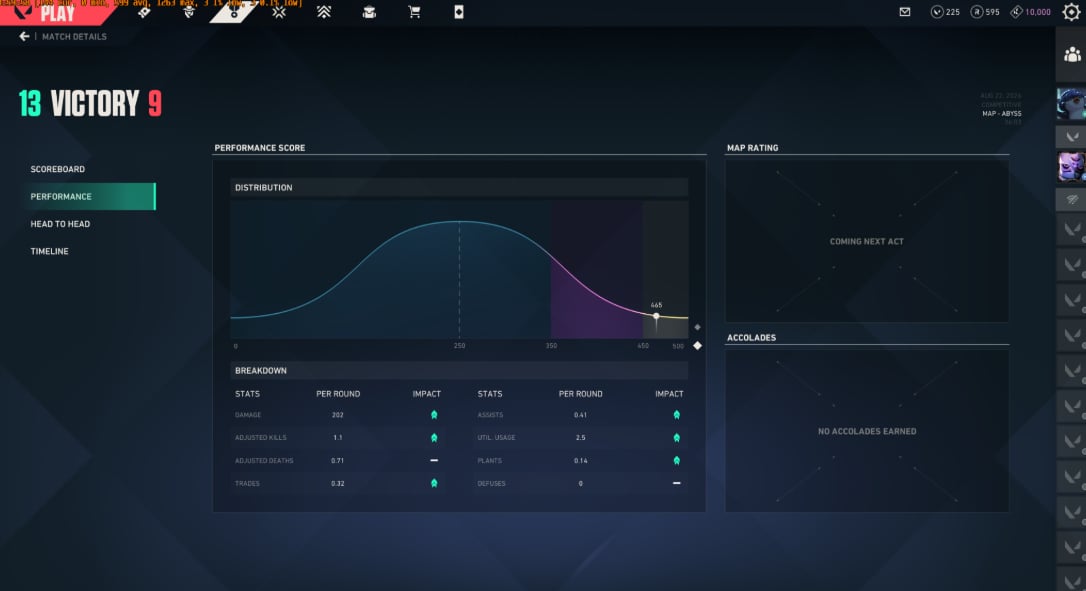
As mentioned, Performance Score takes much more into account than just kills. This is what it actually tracks:
- Damage
- Adjusted Kills
- Adjusted Deaths
- Trades
- Assists
- Utility usage
- Spike plants
- Spike defuses
You can easily see this after a match, or by simply going to your Match History and clicking on a match. It’s under the new Performance Section alongside the Scoreboard, Head-to-Head, and Timeline tabs.
The Performance Score is represented as a number, and it also shows a bell curve. This bell curve shows where you stand compared to other VALORANT players. You can then see the individual factors that are used to calculate your Performance Score.
The sad thing is that the exact formula behind each of these metrics is hidden. So, nobody knows how Performance Score is exactly calculated. We just know what it takes into account. Luckily, most of the metrics make intuitive sense, apart from a few that we will explain.
Adjusted Kills and Deaths
Adjusted Kills and Adjusted Deaths are particularly interesting because they account for the context surrounding a kill or death.
Not every kill has the same value in a round. For instance, First Bloods are considerably more impactful than a kill later down in the round. The same idea applies to deaths. Entry fraggers usually die before their teammates but they do open up the site for the team, so their death is impactful. In a nutshell, the system is attempting to account for the context of deaths rather than treating every death identically.
A 25-kill game can look impressive on paper, but Performance Score has more information to work with when deciding how those kills actually contributed to the match.
Trades
If you’ve ever been the player who runs into a site first, dies, and watches your teammate immediately clean up the enemy, there’s now a little more recognition for that sequence.
Riot confirmed that the Trades statistic counts both securing a trade and being traded. The developers specifically said the goal is to encourage players to enter gunfights together and swing with their teammates.
That means the player getting the kill isn’t the only one receiving credit for the exchange. If you die while your teammate immediately trades your killer, that sequence can contribute to your Performance Score too.
Riot hasn’t publicly disclosed the exact time window used to classify something as a trade, so there’s no reason to start counting seconds in your head during a match.
Utility Usage Is a Bit Different Now
Utility usage is now part of the Performance Score calculation, but Riot isn’t treating every Agent the same way.
This is because all agents have different kits and impact the match differently. The utility usage metric is now normalized per agent and per ability. Before, it would take into account how many times a utility was used and how impactful it was. But this makes it unfair for agents that have kits that aren’t frequently used.
For example, Chamber and Clove have vastly different kits, so judging them by the same raw number of ability uses wouldn’t make much sense. The new system is designed to account for those differences.
Again, we don’t exactly know how it calculates the metric; it’s all in the backend.
What Are Accolades in VALORANT?
Performance Score tells you how you performed in an individual match. Accolades are more about your personal records.
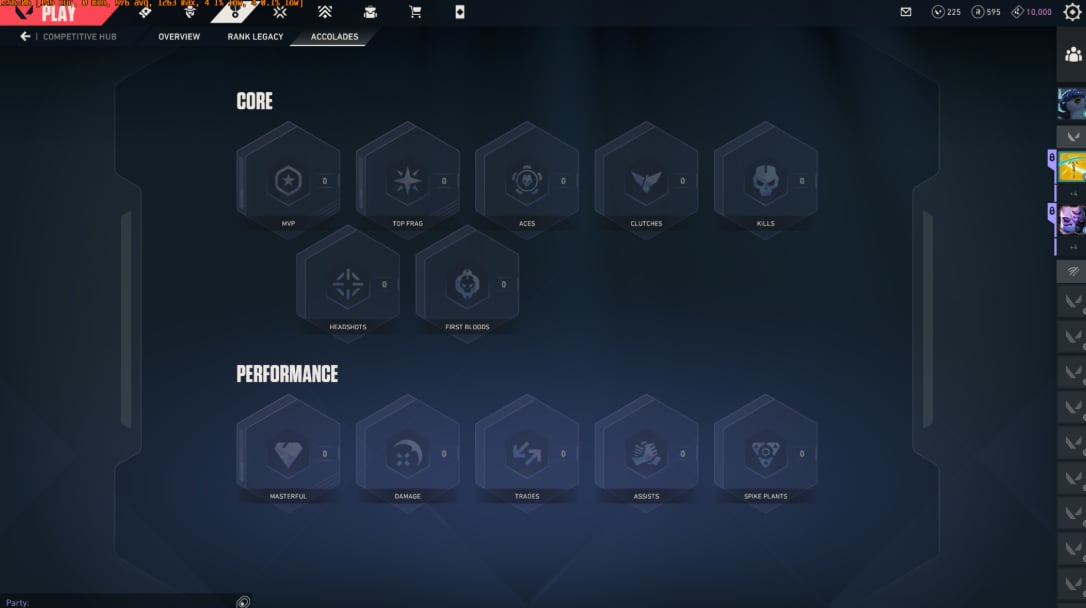
The new system tracks standout achievements across a variety of statistics. Riot gives examples such as how many MVPs you’ve earned during the current Act and your highest kill count in a Competitive game.
Accolades have two types of records: your best performance for the current Act and your best performance across your tracked lifetime.
There is one catch for longtime players.; accolade tracking starts with Patch 13.06, meaning your old matches don’t count.
If you dropped a 50-kill game two years ago, VALORANT isn’t going to dig it out of your match history and award you an Accolade for it. Everyone starts fresh with the system.
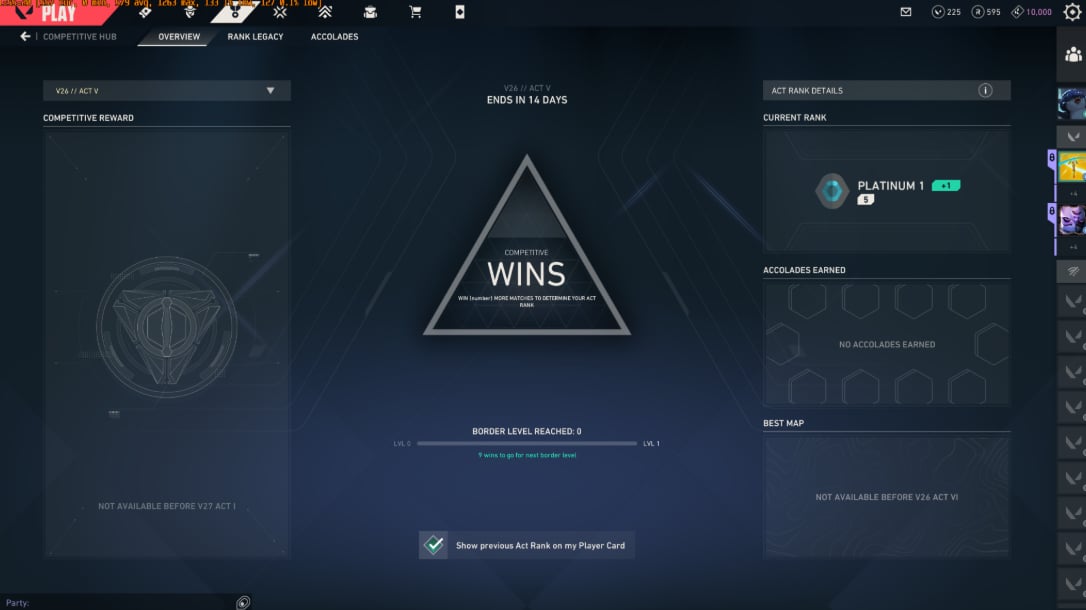
Accolades can only be earned in Competitive and Premier. You can see them on the End of Game screen, including the MVP screen, or open the Competitive Hub to look through your records in more detail.
What Is Rank Legacy?
Rank Legacy is basically a trophy case for your Competitive career.
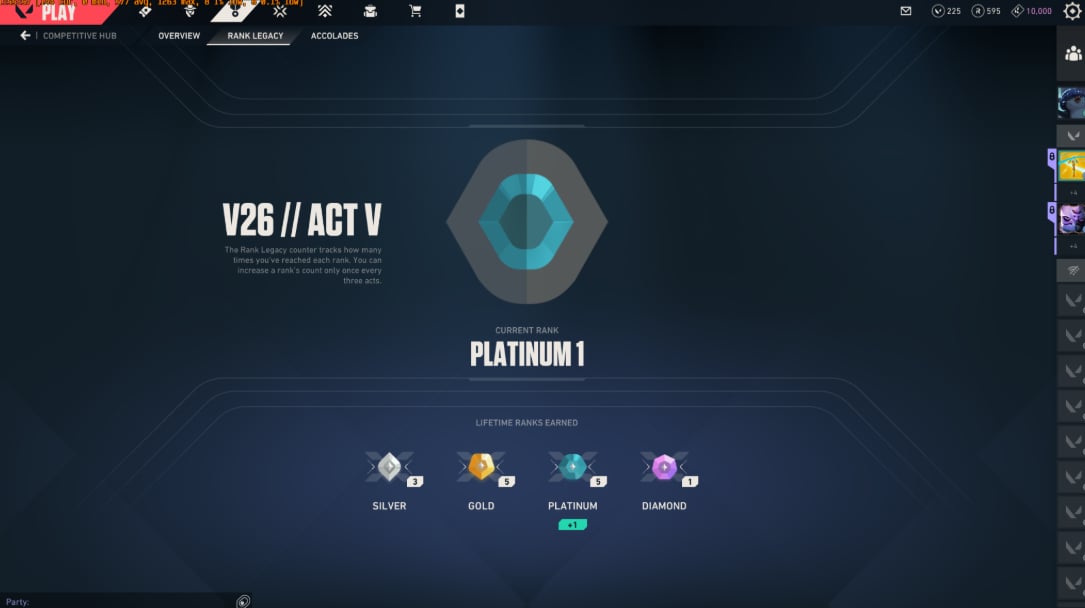
Instead of tracking kills or individual match performances, it keeps track of how many times you’ve reached each rank. You can access it through the Competitive Hub from the Career page and look back at the ranks you’ve achieved over time.
There is a limitation that prevents players from simply bouncing between two ranks and inflating their numbers. Each existing rank can increase its Rank Legacy counter only once every three Acts. Riot divides this into the Act I-III and Act IV-VI periods. Getting demoted into a rank also doesn’t increase its counter.
So Rank Legacy is less about showing every little fluctuation in your rank and more about keeping a record of meaningful competitive milestones.
New Career Page and Competitive Hub
To fit all of these new features and systems, VALORANT’s Career Page had to be reworked.
The new Career page puts your top Agents, Match History, and current rank together in one place. From there, you can access the Competitive Hub, which contains an overview of your current Competitive Act as well as dedicated pages for Accolades and Rank Legacy.
The Competitive Hub is also where Riot plans to showcase some of the competitive features coming in future patches.
There is a privacy distinction worth knowing about. Friends can still view your Career and the Competitive Hub overview, but the dedicated Accolade and Rank Legacy pages are only visible to you.
That makes sense for a system built around personal records. You can show off the career overview without giving everyone a complete breakdown of your competitive history.
Conclusion
This new system is a great way to show players how well they played during a match, and to steer the game away from the typical ‘kills = everything’ idea that is pervasive in online shooters.
Important to note is that these new systems do not impact your ranked progression in any way. You can think of them as achievements or stats to look at to improve yourself. Players already did this with third-party trackers, but now Riot Games is implementing the system in-game.
These systems are still new and are probably going to get tweaked and tinkered with a lot in future patches. So don’t stare yourself blind on your scores or anything like that. As always, you should play your own game and focus on being the best teammate you can be. Everything else will come after that.

